🚀 Bestselling Playbook: Get the 13 blueprints to scale your business.Order "Founder Frameworks" on Amazon →
← Back to Home
BUSINESS OPERATING SYSTEM COMPARISON

The Founder's Guide to EOS Alternatives: Traction vs. Founder Frameworks

A fair, detailed comparison of Gino Wickman's Entrepreneurial Operating System (EOS) and Founder Frameworks across business size, planning depth, execution velocity, and implementation requirements.

At a Glance: How They Compare

EOS (Traction) is an established, corporate-tested operating system best suited for businesses with 10 to 250 employees that already have an executive leadership team in place. Founder Frameworks is built for early-to-growth stage startups (1 to 50 employees) where the founder is actively working to eliminate founder bottlenecks, establish delegation boundaries, and deploy agile weekly sprint execution without high overhead.

Explore Founder Frameworks →Take the 60-Second Diagnostic

7-Dimension Comparison: Founder Frameworks vs. EOS (Traction)

DimensionEOS (Traction)Founder Frameworks
1. Target Business Size10 to 250 employees with an established leadership layer.1 to 50 employees; founder-led teams building their first systems.
2. Planning MethodologyV/TO (Vision/Traction Organizer), 10-Yr Target, 3-Yr Picture, 1-Yr Plan, 90-Day Rocks.Cascading Horizon: Yearly (SLR CAMERAS) → Quarterly (MC BEERS) → Monthly (PC PEERS).
3. Operational ProcessesProcess Component (20/80 high-level core process documentation).Modular SOPs: Granular schemas (RSS FEED SME), system architecture (OKS REC SME), and SaaS process mapping (PFA SAAS SME).
4. Execution PracticesWeekly 90-min Level 10 (L10) Meetings, Scorecard tracking, IDS (Identify, Discuss, Solve).Agile Sprint Rhythm: Weekly sprint planning (PS ERP), daily standups (DC ERPRS), and high-velocity loops (RPM REAP ER).
5. Implementation ModelCommonly guided by Certified EOS Implementers over 1-2 years, or self-implemented.Self-Directed & Modular: Deploy individual frameworks as needed via the book, worksheets, and diagnostic.
6. System ArchitectureMonolithic 6-component model (Vision, People, Data, Issues, Process, Traction).13 Independent Schemas: Pick specific models for planning, SOPs, revenue, or crisis management.
7. AI & Digital ReadinessManual paper/whiteboard roots, adapted into commercial software tools.Native Digital & AI: Clean mnemonic schemas compatible with prompt engineering and private local AI.

Strengths & Limitations of Both Systems

EOS (Traction)

Where EOS Excels:

  • Proven corporate vocabulary understood across thousands of companies
  • Exceptional accountability for mid-sized executive leadership teams
  • Effective meeting cadence (Level 10) for departmental problem-solving
  • Clear separation between Visionary and Integrator roles

EOS Limitations for Early Startups:

  • Assumes department heads exist; challenging when founder holds multiple roles
  • 90-minute weekly meetings can feel heavy for fast-pivoting early teams
  • High financial barrier if using certified external facilitators
  • Less guidance on granular engineering, product, or daily sprint workflows

Founder Frameworks

Where Founder Frameworks Excels:

  • Engineered specifically for founder dependency and delegation bottlenecks
  • Modular deployment—adopt sprint planning today without overhauling entire company
  • Granular tactical blueprints for daily, weekly, monthly, and yearly cadences
  • Completely self-serve via the $13.99 playbook, templates, and free diagnostic

Founder Frameworks Limitations:

  • Requires internal founder discipline without an external third-party coach
  • Less emphasis on enterprise board governance compared to EOS
  • Newer system compared to the decades-old Traction ecosystem

When to Choose Which System

Choose EOS if: You lead an established business with 20 to 250 employees, have functional department leads (Sales, Marketing, Ops, Tech), need cultural alignment across a mid-sized team, and have the budget for external leadership facilitation.

Choose Founder Frameworks if: You are an early or growth-stage founder (1 to 50 employees) who is currently the primary operational bottleneck. If you need actionable delegation models, step-by-step SOP design, and lightweight weekly sprint cadences that your team can run independently, Founder Frameworks is built for your stage.
Explore the Founder Frameworks Methodology

Review all 13 open-source operational blueprints covering planning, operations, and execution—or take our free 60-second diagnostic to identify your team's current friction point.

Explore Founder Frameworks →Identify Your Founder BottleneckGet the Playbook

EOS Alternatives FAQ

Q: Why are founders seeking a business coaching alternative to EOS?

Many founders seek business coaching alternatives because traditional EOS implementations rely heavily on expensive external facilitators (often $5,000 to $10,000+ per session). For startups with fewer than 50 people, spending that capital on external offsite facilitation is often cost-prohibitive compared to self-directed modular frameworks.

Q: Can I use both systems together?

Yes. Many founders use EOS for broad annual alignment and high-level Accountability Charts, but deploy Founder Frameworks (like MC BEERS for quarterly planning and PS ERP for weekly sprints) for day-to-day execution velocity.

Q: How does Founder Frameworks compare to Scaling Up or OKRs?

While Scaling Up (Verne Harnish) and OKRs (Andy Grove / John Doerr) provide strong frameworks for mid-market and enterprise scale, they frequently fail in startups because they require significant administrative maintenance. Founder Frameworks provides lightweight, mnemonic schemas with minimal process overhead.

Q: What is the fastest way to get started with Founder Frameworks?

Start with the free 60-second Business Bottleneck Diagnostic or the Founder Bottleneck Calculator to identify whether your primary operational drag is in Planning, Operations, or Execution. From there, implement the single framework recommended for your gap.

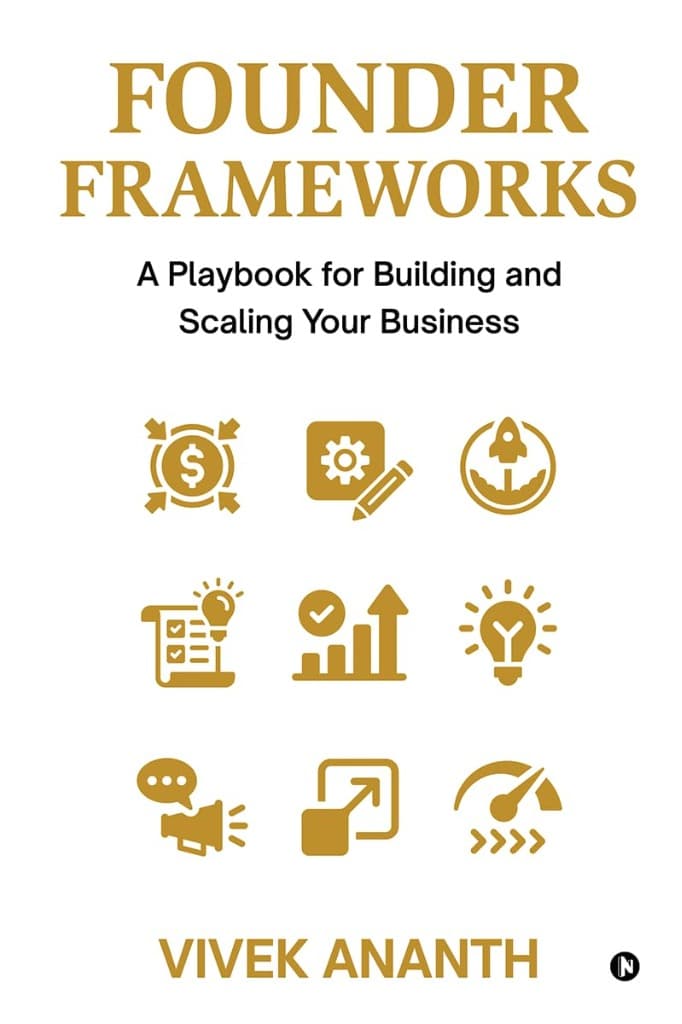
Founder Frameworks Book Cover
The Playbook

Founder Frameworks

Get the complete tactical blueprint to scale your business. Recognized as one of the most practical new business books and entrepreneur books of the year, Vivek Ananth provides 13 actionable operational frameworks covering yearly planning, standard procedures, and execution loops to help you lead without burning out.

"This minimalist take on management gives business leaders useful templates to drive decision-making." — Kirkus Reviews (Featured in the Feb 1, 2026 Issue)

Explore Sample Chapter & Reviews →